
 By Jack Henshaw, Head Writer · Published · Covering 180 studio reviews
This is the reference table we wished existed when we started reviewing slot studios: the published RTP position of every provider we have reviewed — 180 studios — in one place. Each figure is exactly as recorded in our full review, taken from the studio’s own game pages and documentation, never from aggregator listings. Where a studio publishes no reliable provider-wide figure, the table says so, because pretending otherwise is how bad RTP data spreads.
Two things to hold onto while you read. First, these are top published builds: most modern slots also ship in reduced versions, and the figure at your casino is the one printed in the game rules — our highest-RTP providers ranking explains that mechanism in full. Second, a blank is information too: a studio that publishes nothing is asking for more trust than one that documents every build.
More than half of them publish nothing
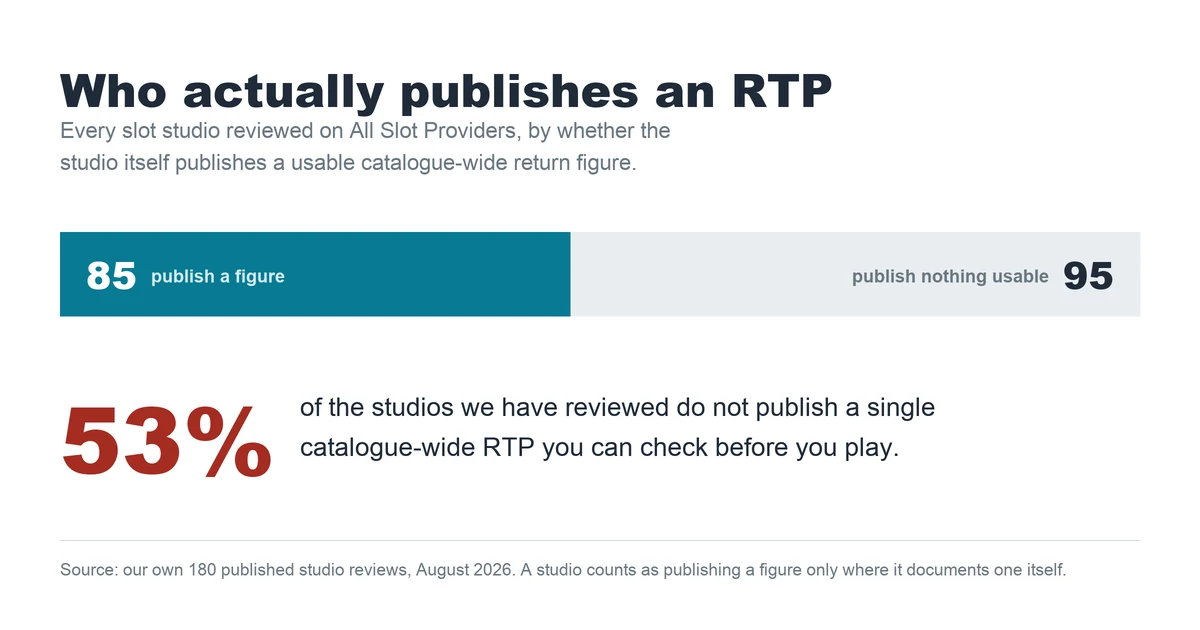
Before any single row matters, one number frames the whole table. Of the 180 studios we have reviewed, 95 do not publish a catalogue-wide return figure you can check. That is 53 per cent — slightly more than half the industry we cover — asking players to accept the maths on trust.
That is not the same as hiding something. Plenty of the silent studios document RTP properly game by game, on individual title pages or in-game information screens, and simply never roll it up into a single house number. For a studio shipping games at several different return settings, refusing to average them is arguably the honest choice. A studio with builds from 94 to 96.5 per cent that advertises “96.5% RTP” across the board is technically publishing a figure and practically misleading you.
But the pattern still matters, because it tells you what kind of homework a game asks of you. When a studio publishes a clear position, you can form an expectation before you open anything. When it does not, the only number that exists is the one inside the game you happen to load, at the casino you happen to use — and you will not know what it is until you are already there.
What the split actually means for you. A published house figure is a starting point, not a guarantee. A missing one is not automatically a red flag. In both cases the binding number is the same: the theoretical return printed in the rules of the specific game, at the specific casino, on the day you play it.
Where the published numbers actually land
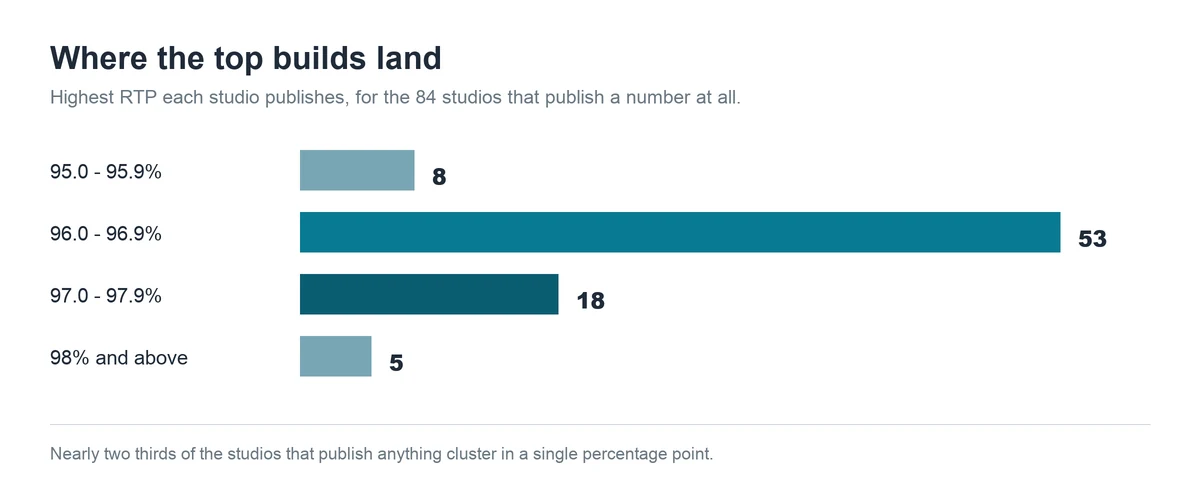
Among the 84 studios where we could pin a number, the spread is far narrower than the marketing suggests. Fifty-three of them — nearly two in three — put their top published build somewhere between 96 and 96.9 per cent. Eighteen reach into the 97s. Five publish something at 98 per cent or above. Eight sit below 96.
That clustering is not a coincidence, and it is not really a choice made by the studios alone. Operators buy the maths they want to run, competitive pressure keeps defaults in a recognisable band, and a studio that sets its flagship materially below the pack in a mature market has a commercial problem rather than a mathematical one. The result is an industry where the difference between a well-regarded studio and an unremarkable one is almost never the headline return figure.
Which is worth saying plainly, because the headline number is what most comparison pages sell you on. A single percentage point of RTP is a real difference over a very long run of play. It is a rounding error over an evening. The things that actually shape a session — volatility, hit frequency, how a bonus round is built, whether the feature you are chasing can realistically be reached — are invisible in a table like this one.
The gap inside a single studio
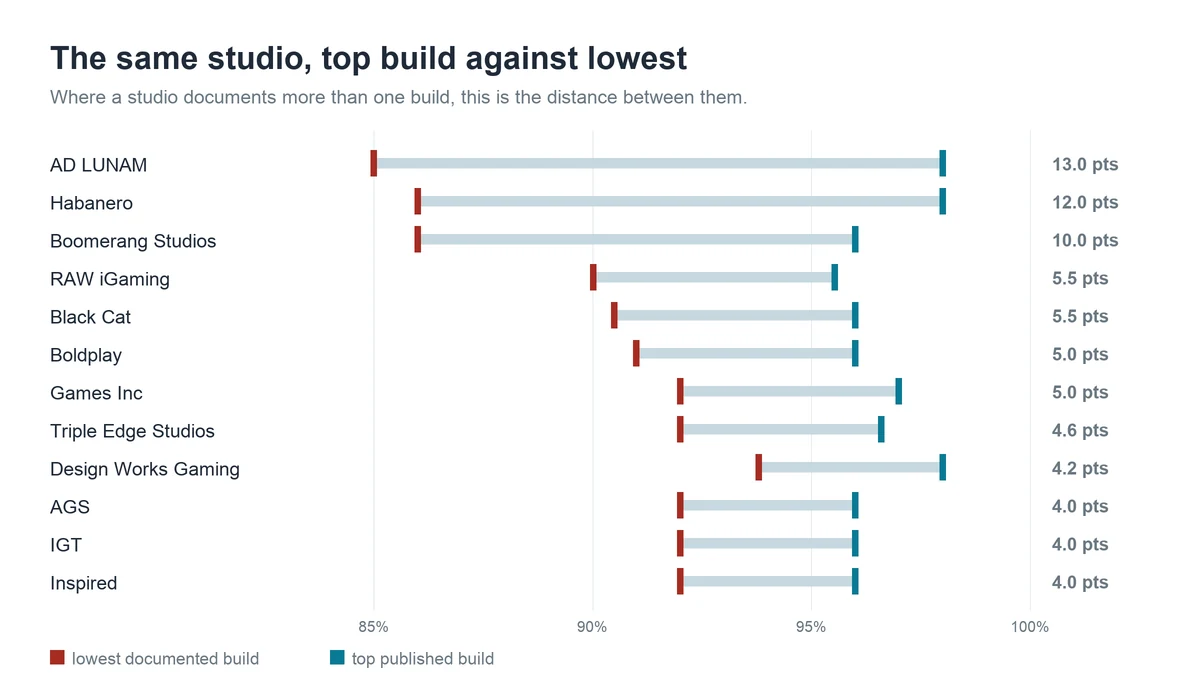
The most useful column in the table is often not the top figure at all — it is the distance between a studio’s best documented build and its worst. Where a studio documents more than one, that distance can be enormous. Several in our table span ten percentage points or more between the version you might read about and the version an operator can actually license.
This is the single most misunderstood thing about slot returns. A game is not one product with one number. The same title, with the same name, artwork and features, is routinely supplied in several mathematical configurations, and which one you get is a decision made by your casino, not by you and not by the studio. The high build is what gets quoted in press releases and review pages. The low build is what quietly appears in some markets and at some operators.
None of this is against the rules. Under Gambling Commission requirements a British casino must make the theoretical return available to you, which is why the figure is in the game rules or information screen of anything you load at a UKGC-licensed site. The rules do not require every operator to license the same build. So the honest reading of any number on this page is: this is the best case the studio has documented, and you should confirm it yourself before you play.
| Provider | Our score | Published RTP (as recorded in our review) |
|---|---|---|
| 1spin4win | 7.1/10 | No single published figure — see review |
| 3 Oaks Gaming | 7/10 | Mostly 95–96% published defaults |
| 4ThePlayer | 8/10 | Around 96%, with several titles at 97% and feature-buy RTP reaching up to 98% |
| ABXplay Games | 6.8/10 | No single published figure — see review |
| AD LUNAM | 8/10 | Top builds from 96% to 98%; lower operator variants can fall to 85% |
| Adell Games | 2/10 | No single published figure — see review |
| AdvantPlay Games | 4/10 | 95.94% to 97.48% |
| AGS | 6/10 | Published defaults mostly in the 92–96% |
| AGT Software | 7.0/10 | No single published figure — see review |
| Ainsworth | 7.8/10 | No single published figure — see review |
| Air Dice | 7/10 | 94.5–96.5% |
| Alchemy Gaming | 8/10 | No single published figure — see review |
| Amatic | 5/10 | ~95–97% |
| Amigo Gaming | 7.2/10 | No single published figure — see review |
| Amusnet | 6/10 | ~95.5–96.5% published |
| Apollo Games | 7.8/10 | No single published figure — see review |
| Apparat Gaming | 8/10 | No single published figure — see review |
| Aristocrat | 6/10 | 94–96% published defaults, with some titles reaching 97% |
| Askmeslot Games | 2/10 | 96.1% to 97.9% |
| Aspect Gaming | 7.4/10 | No single published figure — see review |
| AvatarUX | 8/10 | No single published figure — see review |
| Bang Bang | 6/10 | ~95.7% |
| Belatra Games | 7.4/10 | No single published figure — see review |
| BetConstruct | 7.5/10 | No single published figure — see review |
| BetGames | 5/10 | No single published figure — see review |
| Betixon Games | 8.1/10 | No single published figure — see review |
| Betsoft | 5/10 | Classic era 96.9–97.8%; modern titles ~96.1–96.6% |
| BF Games | 6/10 | ~96% |
| BGAMING | 6/10 | ~94–97.3% |
| Big Time Gaming | 9/10 | No single published figure — see review |
| Bigpot Gaming | 8.1/10 | No single published figure — see review |
| Black Cat | 5/10 | Three selectable operator builds per title — 90.5% / 94% / 96% |
| Blue Guru Games Slots & Slammer Studios | 8.0/10 | No single published figure — see review |
| Blueprint Gaming | 8/10 | Around 95–96% |
| Boldplay | 6/10 | ~91–96% |
| Boomerang Studios Slots and Where to Play (2026) | 6/10 | 95–96% top setting, with lower-tier versions down to 86% on some titles |
| Booming Games | 6/10 | Mostly 95.5–96.5% |
| Booongo | 8.1/10 | No single published figure — see review |
| BT Gaming | 7.8/10 | No single published figure — see review |
| Bulletproof Games | 6/10 | ~95.5% |
| Bullshark Games | 8.0/10 | No single published figure — see review |
| Caleta Gaming | 8.1/10 | From 96.01 to 96.68 per cent |
| Capecod Gaming | 8.0/10 | No single published figure — see review |
| Comtrade Gaming (CG Games) | 6/10 | No single published figure — see review |
| CQ9 Gaming | 6.7/10 | No single published figure — see review |
| Crazy Tooth Studio | 8/10 | No single published figure — see review |
| CT Interactive | 7.9/10 | No single published figure — see review |
| Darwin Gaming | 8.0/10 | No single published figure — see review |
| Degen Studios | 7.7/10 | No single published figure — see review |
| Design Works Gaming Slots UK | 7/10 | Mostly 93.8–98% published figures |
| Dragoon Soft | 7.7/10 | No single published figure — see review |
| DreamSpin | 5/10 | 94–96.5% |
| EGT Digital | 8/10 | No single published figure — see review |
| ELK Studios | 8/10 | Mostly 96–96.3% |
| Endorphina | 7.5/10 | No single published figure — see review |
| Eurasian Gaming | 6.8/10 | No single published figure — see review |
| Every Slot Studio Evolution Owns — And What Each One Cost | — | No single published figure — see review |
| Evoplay Games | 8.5/10 | No single published figure — see review |
| Eyecon | 8.5/10 | ChoiceMany official pages show 93% and 95% |
| Fantasma Games | 8/10 | No single published figure — see review |
| Fortune Factory Studios | 8/10 | No single published figure — see review |
| Foxium | 7.9/10 | No single published figure — see review |
| Fugaso Games | 7.8/10 | No single published figure — see review |
| Galaxsys | 5/10 | ~96–97% |
| GameArt | 7.8/10 | No single published figure — see review |
| Gameburger Studios | 7/10 | No single published figure — see review |
| Gamecode Slots UK | 7/10 | Mostly 94–96.5% published figures |
| Games Global | 8/10 | No single published figure — see review |
| Games Inc | 6/10 | Mid-92% to high-97% |
| Gaming Corps | 5/10 | ~95.8–96.0% |
| Gaming1 Games | 8.4/10 | No single published figure — see review |
| GAMOMAT | 8/10 | Most featured games publish around 96.10% to 96.17% |
| Genii | 7.2/10 | No single published figure — see review |
| Gold Coin Studios | 7.5/10 | No single published figure — see review |
| Greentube | 7.5/10 | Historically lean by online standards — commonly 92–95% |
| Gromada Games | 7/10 | No single published figure — see review |
| Habanero | 6/10 | Operator-selectable bands — roughly 86% to 98% on the same game |
| Hacksaw Gaming | 8.5/10 | 96.2–96.4% |
| High 5 Games | 4/10 | ~94.5–96% |
| Hold Your Hat | 7.5/10 | No single published figure — see review |
| Hölle | 6/10 | ~94–96% |
| IGT | 8/10 | Roughly 92–96% |
| Indigo Magic | 7/10 | No single published figure — see review |
| Inspired | 7/10 | Published defaults span roughly 92–96% |
| Iron Dog Studio | 7/10 | Mostly 94.4–96.2% published defaults |
| iSoftBet | 6/10 | ~95.7–96.1% published |
| Jelly Entertainment | 7/10 | 95–96% |
| Just For The Win | 8/10 | No single published figure — see review |
| KA Gaming | 7.0/10 | No single published figure — see review |
| Kalamba Games | 7/10 | No single published figure — see review |
| KingMidas Games | 7/10 | No single published figure — see review |
| Konami | 5/10 | ~95.5–96.1% |
| Lady Luck | 8.1/10 | No single published figure — see review |
| Leander Games | 6/10 | Mostly 94–96% published defaults |
| Leap Gaming | 8.0/10 | No single published figure — see review |
| Light & Wonder | 8.5/10 | Roughly 95–96% |
| Lightning Box | 8.2/10 | Frequently around 95% to 96%, with version differences |
| Magellan Robotech | 7/10 | No single published figure — see review |
| Mascot Gaming | 7.4/10 | No single published figure — see review |
| Merkur | 8.4/10 | No single published figure — see review |
| Microgaming Games | 8.6/10 | No single published figure — see review |
| Mobilots Games | 7.7/10 | No single published figure — see review |
| MultiSlot Games | 2/10 | No single published figure — see review |
| Neon Valley Studios | 8/10 | No single published figure — see review |
| NetEnt | 9/10 | ~96% published defaults; heritage titles reach 98–99% |
| NetGame Games | 7.2/10 | No single published figure — see review |
| NetGaming | 6/10 | 93.7–96.6% |
| Nolimit City Slots and Where to Play (2026) | 8.5/10 | Remarkably consistent 96.0–96.2% |
| Northern Lights Gaming | 8.4/10 | No single published figure — see review |
| Nucleus Gaming | 6.6/10 | No single published figure — see review |
| Octoplay | 7/10 | Mostly 95.5–96.3% published defaults |
| Oryx Gaming | 7/10 | Mostly 95.5–96.5% published defaults |
| Pascal Gaming Slots UK | 7/10 | Mostly 95.5–96.8% |
| Pateplay Games | 8.0/10 | No single published figure — see review |
| PearFiction | — | No single published figure — see review |
| Peter & Sons | 8/10 | 96.0–96.6% published defaults, floor 95.84%, ceiling 97.00% |
| Platipus Gaming | 6/10 | Mostly 95–96.4% published figures |
| Play’n GO | 8.5/10 | 96.2% |
| Playson | 7/10 | Mostly 94–97%, clustering around 95.5–96% |
| PlayStar Games | 7.3/10 | No single published figure — see review |
| Playtech | 8/10 | Broad: mid-90s on the house line, 96.3–97% |
| Popiplay Games | 6/10 | No single published figure — see review |
| PopOK Gaming | 8.2/10 | No single published figure — see review |
| Pragmatic Play | 8.5/10 | 96.5% headline defaults — but nearly everything ships in 96.5% / 95.5% / 94.5% builds |
| Print Studios | 9/10 | No single published figure — see review |
| Prospect Gaming | 7/10 | Published in three variants per game, typically 95% / 93% / 91% |
| PureRNG Games | 6.2/10 | No single published figure — see review |
| Push Gaming | 8.5/10 | No single published figure — see review |
| Quickspin | 7/10 | ~96–97.35% top models, with 90/94% operator variants |
| Rabcat Games | 7.7/10 | Of 95.5% to 97.75% |
| RAW iGaming | 7/10 | Approximately 90.02%–95.54% |
| Realistic Games | 7.9/10 | No single published figure — see review |
| Red Rake Gaming | 6/10 | 95–96% published defaults |
| Red Tiger | 8/10 | Around 95.7% |
| Reel Kingdom | 7/10 | 96.71% on the early games, 96.0–96.1% on recent sequels |
| Reel Time Gaming | 7/10 | Published defaults mostly in the 94–96% |
| ReelNRG | 4/10 | 94.5–97.4% published defaults |
| ReelPlay | 7/10 | Mostly 95–96% published defaults |
| Reflex Gaming Slots and Where to Play (2026) | 7/10 | No single published figure — see review |
| Relax Gaming | 8.5/10 | No single published figure — see review |
| Retro Gaming | 6/10 | No single published figure — see review |
| Revolver Gaming | 6/10 | ~96% |
| RubyPlay Games | 8.1/10 | No single published figure — see review |
| S Gaming Slots UK | 7/10 | Mostly 93.5–95.5% |
| Shady Lady | — | No single published figure — see review |
| Skillzzgaming | 6/10 | Published defaults from roughly 94.6% to 97% |
| Skywind Group | 6/10 | 95–97% |
| Slingo Games & Gaming Realms | 7/10 | Around 94–96% |
| Slingshot Studios | 8/10 | No single published figure — see review |
| Slotmill | 6/10 | ~96.0–96.2% standard; dual 96%/94% variants since late 2023 |
| Sneaky Slots | 8.0/10 | No single published figure — see review |
| Snowborn Games | 8.5/10 | No single published figure — see review |
| Spadegaming Games | 7.6/10 | Of 96.5% to 97.04% |
| Spinberry Slots and Where to Play (2026) | 5/10 | Mostly 93–96% published defaults |
| Spinmatic Games | 8.2/10 | No single published figure — see review |
| Spinomenal | 6/10 | Mostly 95.5–96.3% published defaults |
| SpinOro Games | 8.1/10 | No single published figure — see review |
| SpinPlay Games | 8/10 | No single published figure — see review |
| Spribe Games | 8.0/10 | No single published figure — see review |
| Stakelogic | 7/10 | Around 95.5–96.3% |
| Stormcraft Studios | 8.6/10 | No single published figure — see review |
| Swintt Slots and Where to Play (2026) | 6/10 | Around 94–96% published defaults |
| Synot Games | 6/10 | ~95–96% |
| TaDa Gaming | 6/10 | 96–97.3% |
| Tech4Bet | 6.6/10 | No single published figure — see review |
| The Better Platform | 8.0/10 | No single published figure — see review |
| Thunderkick | 8/10 | Mostly 96–96.3% |
| Tiptop Games | 7.4/10 | 96% |
| Tom Horn Gaming Slots and Where to Play (2026) | 6/10 | Mostly 94–96.3% published defaults |
| Triple Cherry | 7.1/10 | No single published figure — see review |
| Triple Edge Studios | 7/10 | 92–96.6% |
| Triple Profits | 6.5/10 | No single published figure — see review |
| TrueLab Games | 6/10 | No single published figure — see review |
| Urgent Games | 7.1/10 | No single published figure — see review |
| Wazdan | 7/10 | Mostly 95.5–96.2% |
| Wild Gaming | 5/10 | No single published figure — see review |
| Wizard Games | 8.1/10 | No single published figure — see review |
| WorldMatch Games | 7.6/10 | No single published figure — see review |
| Yggdrasil | 8/10 | Mostly 96.0–96.5% published on the classic shelf, with modern releases nearer 96% |
| Zillion Games | 8.1/10 | No single published figure — see review |
Figures recorded at review time from each studio’s own published material; the in-game paytable at your casino always takes precedence. Scores are each review’s own published verdict.
The standouts, if you only want the headlines
The tallest published flags in the table belong to Relax Gaming, whose Book of 99 carries a 99 per cent default and remains the single biggest number any mainstream studio attaches to a slot; Light & Wonder, whose top Big Bet tiers reach 98 to 99 per cent inside their staked-bundle format; 4ThePlayer, whose feature-buy builds climb to 98 per cent; and TaDa Gaming, with 97 per cent-class defaults across its fortune-jackpot range.
Two cautions belong beside every one of those. The Big Bet format is not a normal spin — it is a bundle of spins bought as one staked package, and its return figure is not directly comparable with a standard base game. And a feature-buy RTP describes the return on the purchase, not on the game as a whole; the base game beneath it usually publishes a lower number. The full context lives in our highest-RTP providers ranking.
At the other end, the lowest floors documented anywhere in the table sit in the mid-eighties. Those are not defaults, and no studio advertises them — they are the reduced builds that exist at the bottom of a supplier’s configurable range. Their presence in a studio’s documentation is exactly why the top figure alone is never the answer.
How to read a provider-wide RTP claim
Four questions separate a figure worth using from one worth ignoring.
Is it the studio’s own number? A figure on an affiliate page, an aggregator listing or a casino’s game blurb has usually been copied several times and updated never. Every figure in our table is traced back to material the studio itself published. Where we could not do that, we left it blank rather than launder someone else’s guess.
Is it a default or a ceiling? “Up to 98%” and “96.5% RTP” are different kinds of statement. The first describes the best configuration that exists somewhere; the second implies what you should normally expect. A studio that only ever quotes a ceiling is telling you less than it appears to be.
Does it cover the whole catalogue or one game? A single flagship title with a spectacular number says very little about the hundred games behind it. This is the most common way a studio’s reputation for generosity gets built on one release.
Does the studio document its lower builds too? This is the real transparency test, and very few pass it. A studio that publishes its full configurable range is telling you something genuinely useful. A studio that publishes only the top of that range is running marketing.
How to check the number at your own casino
Everything above is context. This is the part that actually protects you, and it takes about twenty seconds.
Open the game at the casino you intend to play at. Find the information, rules or paytable screen — usually a small i, a burger menu or a question mark in the game’s own toolbar, not the casino’s. Scroll to the end of the rules. The theoretical return to player is stated there, and at a UKGC-licensed site it must be. That figure, on that day, at that casino, is the one that governs your money.
If it matches the number in our table, good. If it is lower, you have found a reduced build, and that is worth knowing before you stake rather than after. If you cannot find the figure at all, that is itself a reason to be cautious about the site rather than the game.
Two practical notes. Some games display the return only in demo mode or only once loaded for real money, so check both. And on titles with a feature buy, expect to see more than one figure — typically one for the base game and one for each purchase option. They are not interchangeable.
Where these numbers come from
Every row corresponds to a full review on this site. Each review takes its RTP data from primary sources — the studio’s official game pages, in-game information screens and published certification documents — and records the licence position against the Gambling Commission register at the time of writing. Where a review could not tie a figure to a primary source, no figure appears here either.
We deliberately do not fill gaps with aggregator data. Third-party slot databases are useful for finding a game, and unreliable for its maths: they rarely say which build a figure came from, they are seldom corrected when a studio revises a release, and the same wrong number propagates across dozens of sites within a week of first appearing. A blank cell is less satisfying than a number and considerably more honest.
The table is rebuilt whenever the underlying reviews change, so it grows with the review count and corrects itself when a studio revises what it publishes.
Safer play
A higher published return does not make a game safe, and it does not make a session more likely to end ahead. Over any period you will actually play, variance dominates the return figure completely. Treat RTP as a way of telling badly built products from well built ones, never as a strategy.
Set a deposit limit before you start rather than during. If gambling has stopped being entertainment, BeGambleAware offers free, confidential support, and GAMSTOP can block you from every UKGC-licensed site at once.
Provider RTP: FAQs
Which slot provider has the highest published RTP?
Relax Gaming, whose Book of 99 carries a 99 per cent published default — the single biggest number any mainstream studio attaches to a slot. Light & Wonder’s Big Bet tiers reach 98 to 99 per cent within their staked-bundle format, though that format is not directly comparable with an ordinary base game.
Why do some providers show no figure at all?
Because they publish none, or publish figures too inconsistently for a single statement to be honest. Our reviews document RTP per game where it exists; when a studio-wide figure would have to be invented rather than sourced, this table says so instead.
Is the figure here the one I will get at my casino?
Not necessarily. These are top published builds, and operators can license reduced versions of the same game. The theoretical return line in the game rules at your casino is the binding number.
How many studios publish a usable figure?
Eighty-five of the 180 we have reviewed, or 47 per cent. The other 95 publish nothing you can check at catalogue level, though many still document individual games properly.
What is a normal RTP for an online slot?
Among the studios in this table that publish anything, the top build sits between 96 and 96.9 per cent in nearly two thirds of cases. Anything materially below 94 per cent on a default build is worth a second look, and anything advertised above 98 is almost always a special format such as a feature buy or a staked bundle.
Can a casino change a game’s RTP?
A casino cannot alter a game while you are playing it, but it can choose which configuration of that game to license in the first place. That decision is made before the game ever reaches your screen, which is why the in-game rules screen matters more than any figure published elsewhere.
How current is this table?
It reflects our published reviews as they stand, and is refreshed alongside them. The date under the byline shows the most recent update.
Jack reviews the studios behind the UK’s online slots, checking every licence claim against the Gambling Commission register and every return figure against the studio’s own published material.