
 By Jack Henshaw, Head Writer · Published · Licence position checked against the Gambling Commission register
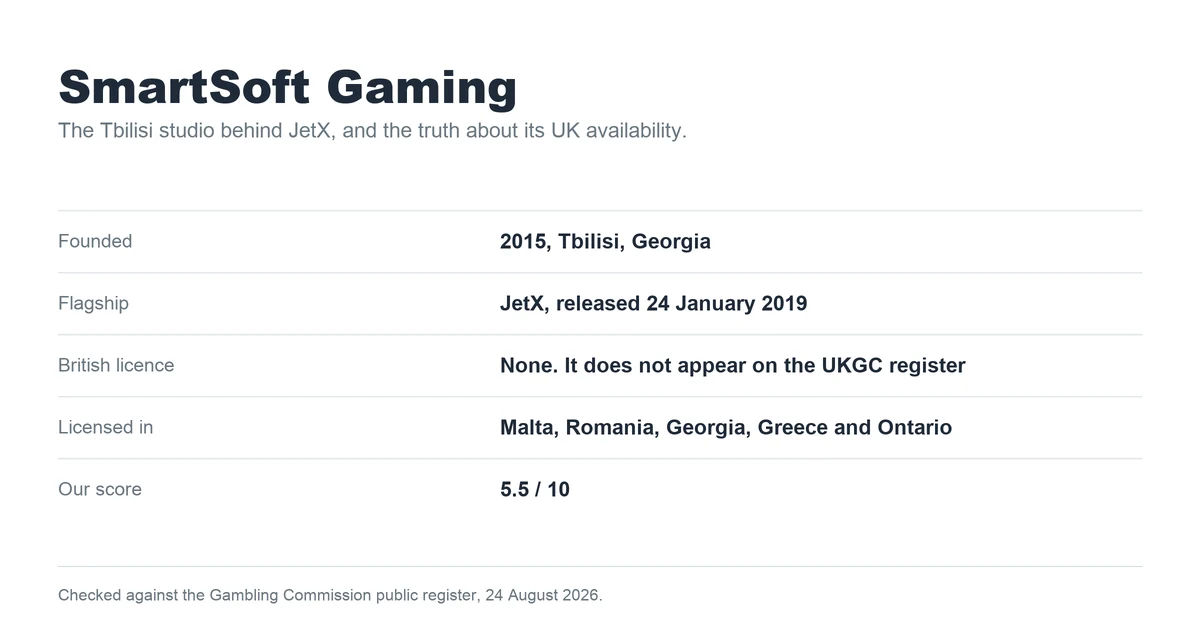
On 24 January 2019 a studio in Tbilisi released a game in which a jet takes off, a multiplier climbs, and you decide when to jump. JetX reached market about three weeks before Spribe’s Aviator, and between them the two built the regulated crash category. This review covers what SmartSoft actually did and did not invent, its unusually high published returns, and the definitive answer on British availability: it has never held a UK licence.
SmartSoft Gaming at a glance
| Founded | 2015, Tbilisi, Georgia |
| Flagship | JetX, released 24 January 2019 |
| Catalogue | More than 100 titles across crash, slots and instant-win |
| Published RTP | JetX 96.70% to 98.80% depending on build; JetX3 at 97% |
| Licensed in | Malta (MGA/B2B/925/2021), Romania, Georgia, Greece and Ontario |
| British licence | None. No record on the Gambling Commission register |
| UK availability | Not available at a UKGC-licensed casino |
| Our score | 5.5/10 — full verdict below |
Licence position verified against the Gambling Commission public register, 24 August 2026.
Who actually invented the crash game
SmartSoft is routinely credited with inventing the crash game, and the claim needs unpicking, because the honest version is more interesting than the marketing one.
JetX launched on 24 January 2019, roughly three weeks ahead of Spribe’s Aviator. Between them those two titles built the crash category as the regulated gambling industry now knows it: a single multiplier climbing in real time, a cash-out button, and a live social feed showing whose nerve failed before yours.
But the format itself is older than both. Multiplier-and-cash-out games circulated in the Bitcoin gambling world for years before either title existed, and the underlying idea — a rising curve that busts at a randomly determined point, with a provably fair seed — was well established in that world by the mid-2010s. What SmartSoft did was not invent the mechanic. It brought the mechanic into licensed, regulated casino lobbies and made it work there.
That is a genuine achievement and it deserves credit. It is simply a different claim from the one usually made, and the difference matters on a site that checks things. The defensible statement is that JetX was first to market in the regulated crash category, not that SmartSoft invented crash games.
JetX, and what it actually is
A jet takes off. A multiplier climbs from 1.00x. At an unpredictable moment the jet explodes and everything not already cashed out is lost. You may place two bets per round, cash them out independently, and set automatic cash-out points in advance.
Everything that makes crash games compelling is social rather than mechanical. The round is shared: every player is in the same flight, on the same curve, and the feed shows their bets and exits live. That converts a solitary decision into a visible one, and it is why the format spread far faster than its actual gameplay depth warrants. There is no bonus round here, no free spins, no feature to chase. There is one decision, repeated.
The studio has extended the idea rather than replaced it. JetX3 runs three simultaneous flights on one screen, and the wider range moves the same curve into other costumes — football, balloons, hot-air ballooning over Cappadocia. The mechanic is identical in each.
The maths, which are unusually good
JetX publishes between 96.70 and 98.80 per cent depending on the build, with JetX3 at 97 per cent. Those are high figures by any standard. Against our provider RTP table, where two thirds of studios that publish anything put their top build between 96 and 96.9 per cent, the top JetX build would sit near the summit of the industry.
Crash games can afford it, and the reason is structural. There is no bonus round to fund, no jackpot contribution, no feature-buy economy and no progressive pool. The house edge lives entirely in the crash curve, which makes the maths unusually simple and unusually cheap to run at a high return.
That is the good news. The warning sits inside the same sentence: the spread between 96.70 and 98.80 per cent is more than two full percentage points between builds of the same game. Whichever one your casino licensed is the one you get, and the difference between the top and bottom configurations here is larger than the difference between most studios’ best and worst games.
The honest caveat about high crash RTP. A 98 per cent return does not make a crash game safe or slow. These games are extremely high frequency — a round lasts seconds, and nothing stops you playing hundreds in an hour. Return per stake is not the same as money at risk per hour, and crash is the format where those two numbers diverge most sharply.
The UK position, definitively
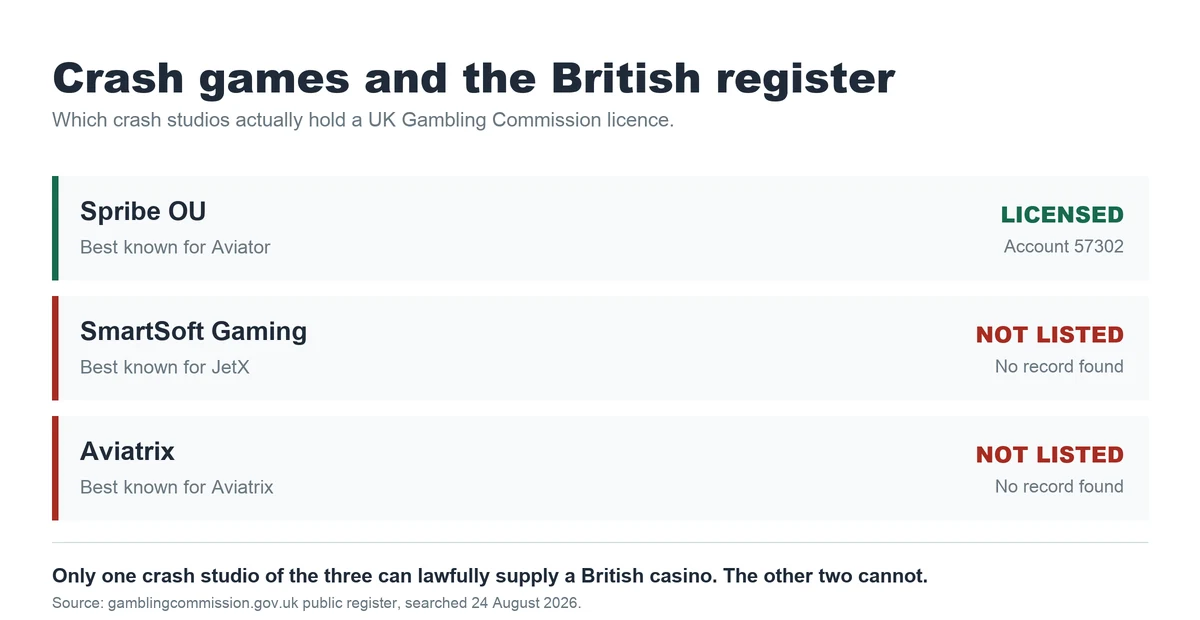
We searched the Gambling Commission’s public register directly. There is no record of SmartSoft Gaming. Not as a licence holder, not as a trading name, and not among the surrendered, lapsed or revoked entries the register retains — which means it has never held a British licence.
The contrast with its closest rival is instructive. Spribe, the studio behind Aviator, is on the register at account 57302. The two games launched three weeks apart in 2019. One took the regulatory route into Britain and one did not.
SmartSoft’s own published licensing covers Malta, Romania, Georgia, Greece and Ontario. That is a real and respectable list — this is a properly regulated business in the markets it serves. Britain is simply not one of them.
The practical consequence is unambiguous. Under section 41 of the Gambling Act 2005, supplying gambling software into Great Britain in the course of a business requires an operating licence. SmartSoft holds none, so you will not find JetX at a UKGC-licensed casino. If you have played it, you played at a site operating outside British regulation, which means no Gambling Commission protection, no access to the British complaints route, and no GAMSTOP coverage.
That is not a criticism of the game. It is a description of where you were standing while you played it.
The wider range
The catalogue runs past a hundred titles and covers crash, slots and instant-win formats. The crash family is the part worth knowing: JetX and JetX3, plus themed variations including Football X, Balloon X and Cappadocia.
Beyond that the slots are conventional and not especially distinguished. The studio’s identity is entirely bound up in one mechanic and one game, which is both its strength and the reason a British player has little reason to seek out the rest of it even if it were available.
How it compares
| Against Spribe | The direct comparison, and the one that matters. Aviator launched three weeks after JetX and is the more famous game. Crucially, Spribe holds a British licence and SmartSoft does not, so for a UK player the two are not alternatives at all. |
| Against Aviatrix | Both are outside British regulation. Aviatrix has the more original idea and a single title; SmartSoft has the deeper catalogue and got there first. |
| Against an ordinary slot studio | Not really comparable. Crash publishes far higher returns because there is no feature economy to fund, but it also runs at a speed no slot matches. Judge it on rounds per hour, not on RTP. |
Positions as at August 2026.
Safer play
A studio’s reputation, its licences and its published returns tell you whether a game is built properly. None of them tells you a session will go well. Over any period you will actually play, variance dominates the return figure completely.
Decide what an evening is worth before you open anything, and set a deposit limit at your casino rather than relying on judgement in the moment. If gambling has stopped being entertainment, BeGambleAware offers free, confidential support, and GAMSTOP blocks you from every UKGC-licensed site at once.
Our verdict
All Slot Providers score: 5.5/10.
SmartSoft built one of the most influential gambling products of the last decade. JetX brought a format that had lived in the crypto-gambling margins into licensed casino lobbies, and effectively every crash game since has been answering it. The published maths are genuinely among the best in the industry, and the studio holds real licences in five jurisdictions.
For a British player, none of that is reachable. The studio has never held a UK licence, its games are not available at any UKGC-licensed casino, and the rival that launched three weeks later took the regulated route and is available. That is the whole practical story.
The score reflects both halves. Real influence, real maths, real licensing — and, in Britain, no lawful way to play it. If you want the format, Aviator is the licensed answer.
SmartSoft Gaming: FAQs
Who invented the crash game?
Not SmartSoft, strictly. Multiplier-and-cash-out games existed in the Bitcoin gambling world before JetX. What SmartSoft did was bring the format into licensed casino lobbies: JetX launched on 24 January 2019, about three weeks before Spribe’s Aviator, and the two of them created the regulated crash category.
What is JetX’s RTP?
Between 96.70 and 98.80 per cent depending on the build the operator licensed, with JetX3 at 97 per cent. That spread is more than two percentage points on the same game, so the in-game figure is the one that counts.
Can I play JetX in the UK?
No. SmartSoft Gaming does not appear on the UK Gambling Commission register in any status, so it cannot lawfully supply British casinos and its games are not available at UKGC-licensed sites.
Is SmartSoft Gaming licensed anywhere?
Yes, in several places: Malta under MGA/B2B/925/2021, plus Romania, Georgia, Greece and Ontario. It is a properly regulated supplier in the markets it serves. Britain is not one of them.
Where is SmartSoft Gaming based?
Tbilisi, Georgia, where it was founded in 2015.
Is JetX the same as Aviator?
No, though they are near-identical in format and launched three weeks apart in 2019. JetX is SmartSoft’s; Aviator is Spribe’s. The practical difference for a British player is that Spribe holds a UK licence and SmartSoft does not.
Jack reviews the studios behind the UK’s online slots, checking every licence claim against the Gambling Commission register and every return figure against the studio’s own published material.