
 By Jack Henshaw, Head Writer · Published · Licences checked against the Gambling Commission register
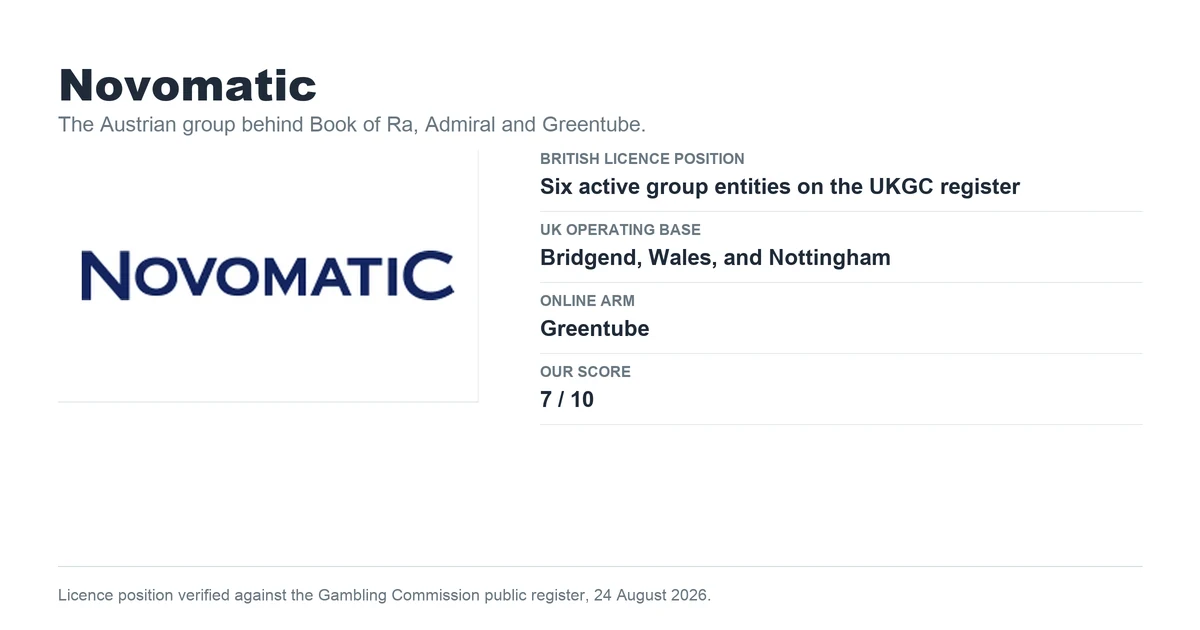
Novomatic is one of the largest gambling technology groups in the world — the Austrian business behind the Admiral machines, the Book of Ra dynasty and, through its Greentube subsidiary, one of the most influential online catalogues in Europe. This page reviews the group itself: where it came from, how its brands fit together, exactly what it holds on the British register, and which review to read for the games.
Novomatic at a glance
| Founded | September 1980, Gumpoldskirchen, Austria — still family controlled |
| Headquarters | Gumpoldskirchen, Austria |
| Scale | €3,453.4m revenue and 26,200+ staff across 206 subsidiaries (2024) |
| Machine brand | ADMIRAL — the gaming-machine name the group launched with in 1980 |
| Online arm | Greentube, acquired outright in 2010 |
| Defining game | Book of Ra — the slot that founded the “book” genre |
| British licences | Six active group entities on the Gambling Commission register |
| UK revenue | €380.5m in 2024, up 17.3% — the group’s fastest-growing market |
| UK operating bases | Bridgend, Wales; Nottingham; Alderney; Gibraltar |
| Our score | 7/10 — full verdict below |
Licence data from the Gambling Commission public register, checked 24 August 2026.
From imported machines to a European group
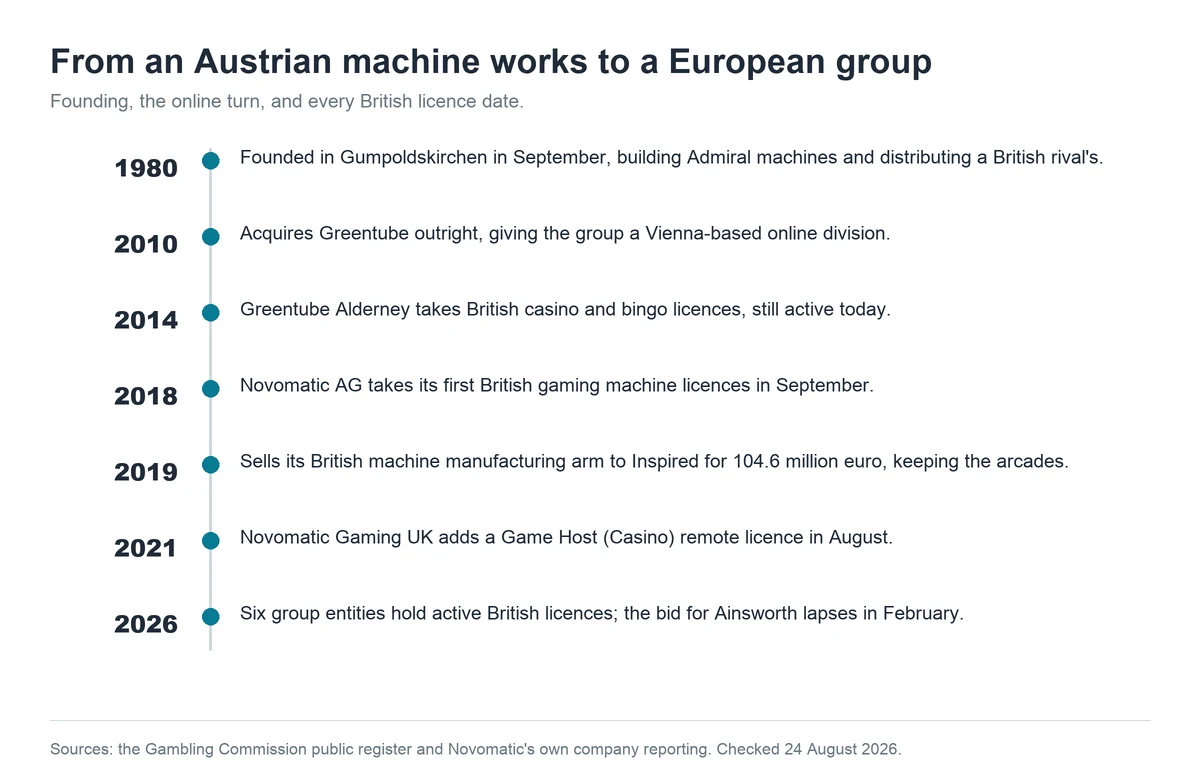
Novomatic was founded in September 1980 in Gumpoldskirchen, the Lower Austrian town where its headquarters still sits. Its first business was twofold: manufacturing its own gaming machines under the ADMIRAL name, and acting as distribution agent in Austria for the British manufacturer JPM.
That second detail is worth noting, because it is the opposite of the story usually told about this company. A widely repeated origin has the business starting as an importer of Belgian pinball machines. We went looking for a source for that and could not find one. What is documented is a machine manufacturer that also distributed a British rival’s products — which makes its later British expansion look less like a leap and more like a return.
Four and a half decades later the group reported revenue of €3.45 billion for 2024, with more than 26,200 staff across 206 subsidiaries, spanning machine manufacturing, casino and arcade operation, betting technology and online gaming. It remains privately controlled by its founding family through two holding companies, which is rarer than it sounds: almost every comparable business at this scale is listed, private-equity owned, or has been through both. Only Light & Wonder and IGT occupy genuinely comparable territory, and both are public companies answerable to quarterly expectations that Novomatic simply does not have.
That ownership structure explains a lot about how the group behaves. It has never needed to chase the online-first, high-volatility fashion that reshaped the supplier market after 2018. It kept building cabinets. It kept its distribution in-house. And it kept selling a catalogue of games whose commercial logic was established before most of its current competitors existed.
The two Novomatics
For a slot player the group resolves into two quite different things, and confusing them is the most common mistake people make about it.
The first is the land-based inheritance: the Admiral machines and the Novomatic cabinet catalogue, whose greatest hits defined continental European gambling the way Barcrest defined Britain’s. If you have played a slot in a bar in Austria, Germany, Italy or the Balkans, you have almost certainly played a Novomatic cabinet without noticing the name.
The second is Greentube, the Vienna-based online division the group acquired outright in 2010 and now operates as its interactive arm. Greentube converts that land-based inheritance for the internet and builds new games alongside it. When a British player meets a Novomatic game online, they are almost always meeting a Greentube build of it.
Which review should you read? This page is the corporate context: who owns what, which entity holds which licence, and how the brands fit together. If you want the online catalogue judged as a catalogue — game quality, published maths, mobile behaviour — our Greentube review is the one that scores it, at 7.5/10.
Book of Ra, and why it matters more than any single game
Book of Ra’s expanding-symbol free spins did not just make a successful slot. They created an entire genre, and that genre is now one of the most-copied structures in the industry.
The mechanic is simple enough to describe in a sentence: trigger free spins, and a single symbol is chosen at random to expand across an entire reel whenever enough of it lands, paying regardless of position. That one idea — a random expanding special symbol, selected before the round rather than during it — turned a modest base game into a feature people would chase for hours.
Play’n GO’s Book of Dead, the biggest British online slot of the last decade, is structurally a Book of Ra descendant. So are the hundreds of “Book of” titles across effectively every supplier’s catalogue. Few slots in history have been imitated more thoroughly, and unusually, the imitations have mostly out-earned the original in the markets that matter to British players.
The original family — Book of Ra, its Deluxe editions and their many spin-offs — remains the group’s calling card. It is worth being honest about what it offers a modern player, though: modest published maths carried a very long way by mechanical fame. The game that invented the format is no longer the best example of it.
The classic shelf
Behind Book of Ra sits a shelf of titles that work the same trade: Sizzling Hot, Lucky Lady’s Charm, Lord of the Ocean, Dolphin’s Pearl. Simple, iconic, and genuinely everywhere in continental Europe.
These games share a design philosophy that has almost vanished from new releases. Few paylines. No cascades. No feature buy. No multiplier ladder. A base game that pays small and often, and one bonus round that everyone in the venue understands without reading anything. That is a cabinet design, built for a machine in a bar where the player has ninety seconds and no patience for a tutorial.
Transposed online, that simplicity reads two ways. To a player raised on Megaways and cluster grids, it can feel thin — there is genuinely less happening per spin than in almost any modern release. To a player who finds contemporary slots exhausting, it is the whole appeal. Both reactions are reasonable, and which one you have is the single best predictor of whether you will enjoy this catalogue.
The British licence position
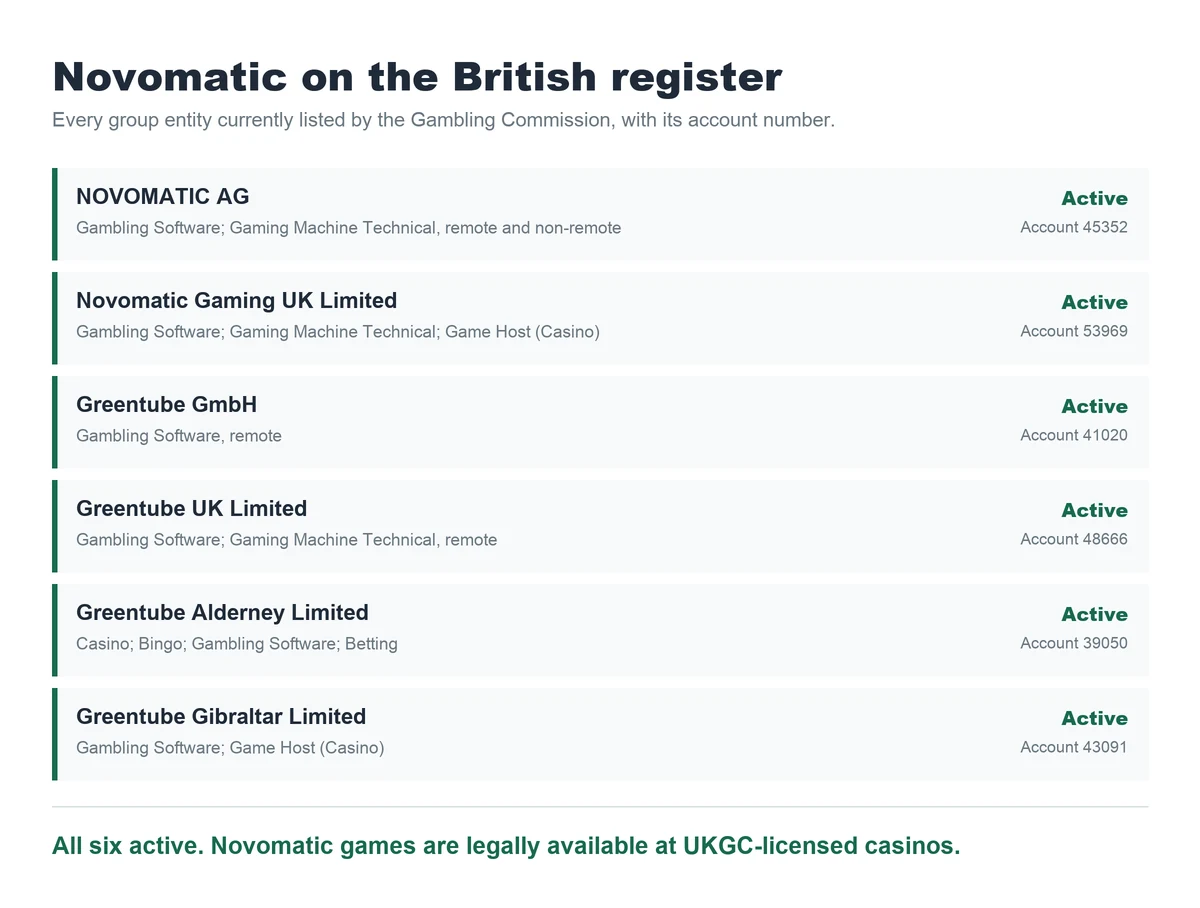
Novomatic’s British footprint is larger and more layered than most suppliers’, because the group licenses its land-based business and its online business separately, and licenses its online business through more than one jurisdiction.
NOVOMATIC AG itself holds British licences under account 45352, covering gambling software and gaming machine technical activity in both remote and non-remote form. The machine licences date from September 2018 and the software licences from May 2019.
Novomatic Gaming UK Limited, account 53969, operates from Astra House in Bridgend, South Wales — the group’s British manufacturing and operations base. It holds a fuller set than the parent, including a Game Host (Casino) remote licence added in August 2021.
On the online side, four Greentube entities hold current licences: Greentube GmbH in Vienna (41020), Greentube UK Limited in Nottingham (48666), Greentube Alderney Limited (39050) and Greentube Gibraltar Limited (43091). The Alderney entity is the one that matters most to a player, because it holds the casino and bingo operating licences — it runs a consumer-facing site, not just software supply.
The practical answer is straightforward. Novomatic games are legally available at British casinos, the group is fully licensed to supply them, and it also operates its own licensed site. Nothing here requires a caveat, which is not something we can say about every studio on this site.
Where a British player actually meets these games
Three routes, and they are not equally likely.
Admiral’s own site. The group’s UK-facing casino operates under the Greentube Alderney licences and carries the catalogue directly. This is the most complete Novomatic shelf a British player can reach, for the obvious reason that the group has no incentive to hold anything back from itself.
Third-party casinos. Greentube supplies content to other operators, so Novomatic titles do appear in ordinary British lobbies — but less consistently than titles from studios whose whole business is supply. Novomatic has always preferred owning its distribution to renting someone else’s, and it shows in how thinly the catalogue is spread across the market.
The high street. Realistically, the most likely place a British player has already met a Novomatic game is on a machine rather than a screen, in an arcade or a bingo hall. But the shape of that business changed sharply in October 2019, when Novomatic sold its British gaming machine manufacturing arm to Inspired Entertainment for €104.6 million, keeping its arcade estate. Astra and Bell-Fruit, long treated as Novomatic brands in British coverage, have not been since.
Britain nonetheless remains commercially important to the group, and increasingly so: Novomatic’s 2024 report puts UK revenue at €380.5 million, up 17.3 per cent on the year and the fastest growth of any market it operates in.
What the maths actually look like
This is where the heritage catalogue costs you something. Our Greentube review records published returns that sit lean by modern online standards, commonly in the 92 to 95 per cent range, against an industry where two thirds of studios that publish anything put their top build between 96 and 96.9 per cent.
Two things are going on. The first is genuine: cabinet games have historically run at lower returns than online-native ones, because the economics of a machine in a bar are not the economics of a website, and a catalogue built on converted cabinet maths carries that history with it. The second is disclosure. Novomatic and Greentube publish less RTP detail than studios that grew up online, where documenting every build became a competitive habit rather than a regulatory one.
Neither is a scandal, and neither is hidden — at a UKGC-licensed casino the theoretical return is in the game’s own rules screen, as it must be. But the gap between the catalogue figure and the figure you are actually served can be wide. Checking a British licensed operator’s live game client, Book of Ra Deluxe was running at 92.13 per cent, with a maximum win of 5,010 times stake and a stake range of 10p to £5. That is a long way below the mid-nineties the family is usually credited with.
So the checking step matters more here than with a studio that publishes its full range. Open the game, find the rules, read the figure, and do it per title rather than assuming the catalogue is consistent. On this catalogue in particular, assume you have been given a lower build until the rules screen tells you otherwise.
How Novomatic compares
| Against Light & Wonder | The closest structural peer — both own heritage catalogues attached to living machine businesses. Light & Wonder publishes better maths and moves faster online; Novomatic has the stronger continental European position and stays private. |
| Against IGT | Comparable scale and a similar land-based-first history. IGT’s British online presence is more visible in third-party lobbies; Novomatic’s is concentrated in its own. |
| Against Pragmatic Play | Not really a comparison. Pragmatic is an online-native volume machine shipping several titles a month at documented 96.5 per cent defaults. Novomatic is a manufacturer with an online division. |
| Against Barcrest | The instructive one. Both defined a national gambling culture through machines — Novomatic continental Europe, Barcrest Britain. Novomatic still owns and runs its own name; Barcrest is a brand inside somebody else’s group. |
Comparisons reflect the position for a British player in August 2026.
Safer play
A studio’s reputation, its licences and its published returns tell you whether a game is built properly. None of them tells you a session will go well. Over any period you will actually play, variance dominates the return figure completely.
Decide what an evening is worth before you open anything, and set a deposit limit at your casino rather than relying on judgement in the moment. If gambling has stopped being entertainment, BeGambleAware offers free, confidential support, and GAMSTOP blocks you from every UKGC-licensed site at once.
Our verdict
All Slot Providers score: 7/10, scored as a group, with the online detail living in our Greentube review at 7.5/10.
Catalogue depth is immense and the historic innovation is genre-founding — the “book” format alone reshaped what a slot bonus round looks like, and it did so permanently. The British licence position is as clean as it gets: six active entities, nothing lapsed, nothing ambiguous.
What holds the score down for a modern British player is specific rather than general. Published maths on the classics sits in the mid-nineties with little disclosure flourish. The mobile experience is competent rather than leading. And current output trades on heritage more than invention — you are being sold the memory of Book of Ra more often than you are being sold a new idea.
Novomatic is to continental Europe what Light & Wonder is to the Anglophone world: a museum-grade catalogue attached to a very much living machine empire. If you want the history, it is unmatched. If you want the best available maths, it is not where to look. The right way in for a British player is the Greentube shelf, with the rules screen open.
Novomatic: FAQs
Is Novomatic the same as Greentube?
Greentube is Novomatic’s online division, acquired outright in 2010. Novomatic is the parent group, which also builds gaming machines and operates venues. On the British register they appear as separate licensed entities: NOVOMATIC AG under account 45352, Greentube GmbH under 41020, and three more Greentube companies besides.
Who owns Novomatic?
It remains privately controlled by its founding family through two holding companies, making it one of the largest privately held gambling groups in the world. It is not listed on any stock exchange.
Can I play Novomatic slots in the UK?
Yes. Six group entities hold active British licences, including operating licences held by Greentube Alderney Limited, so the games are legally available at UKGC-licensed casinos. The fullest catalogue sits on the group’s own Admiral site.
What is Novomatic’s most famous slot?
Book of Ra, whose expanding-symbol free spins created the entire “book” genre. Play’n GO’s Book of Dead and hundreds of other titles are structurally descended from it.
Are Novomatic slots high RTP?
No. Published returns sit lean by modern online standards, commonly in the 92 to 95 per cent range. Checked live at a British licensed operator, Book of Ra Deluxe was running at 92.13 per cent. Always read the rules screen of the specific game at your casino.
Where is Novomatic based in the UK?
Its British operations run from Astra House in Bridgend, South Wales, under Novomatic Gaming UK Limited, account 53969. Greentube UK Limited operates separately from Nottingham.
Is Admiral the same company as Novomatic?
Admiral is Novomatic’s own brand, used on gaming machines since 1980 and on the group’s casino and betting venues and websites. It is a brand, not a separate company.
Jack reviews the studios behind the UK’s online slots, checking every licence claim against the Gambling Commission register and every return figure against the studio’s own published material.