

Sixty-nine slot suppliers have handed back every British licence they held. Some genuinely walked away, some were absorbed by a parent, and several are trading in the UK today despite the word “surrendered” sitting against their name on the Gambling Commission’s register. This guide separates the three, names the studios and dates in each group, and shows why the Commission’s own public search will tell you a licensed studio does not exist.
Where to Play Slots From Studios Still in the UK



What “surrendered” actually means on the UKGC register
A surrendered licence is one the holder gave back voluntarily. It is not a revocation, it is not a suspension, and on its own it says nothing about whether the company did anything wrong. The Commission records the activity, the licence number, the start date and the end date, and then leaves the entry in place.
That last part is where most published lists go wrong. A surrendered entry looks almost identical to an active one at a glance, so “licensed slot providers” lists built by skimming the register keep naming studios that handed their permissions back years ago. The opposite error is just as common: assuming a surrender means the studio’s games have vanished from British casinos, when very often they have not moved at all.
Across the current register, 406 business accounts have surrendered every licence they held and another 26 have surrendered some while keeping others. Restricting that to the activities a slot studio actually needs, which are Gambling Software, Game Host (Casino) and Gaming Machine Technical Software, leaves 69 supplier accounts that have fully exited. Those 69 are the real subject of this page.
The three kinds of exit, and why the difference matters
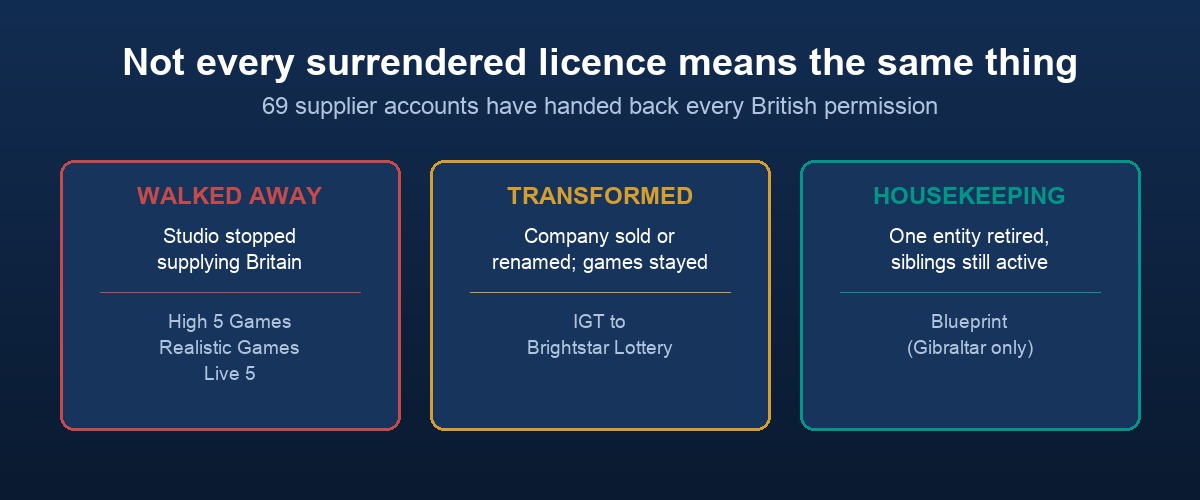
Sorting those 69 by what actually happened next produces three groups that behave completely differently for a British player. One group means the games are gone. One means nothing changed except a company name. One means the studio is still supplying UK casinos right now.
| Group | What happened | Can you still play the games in the UK? |
|---|---|---|
| Walked away | The studio stopped supplying Britain, and in several cases stopped trading entirely | No, or only until operators clear the catalogue |
| Corporate transformation | The licensed company was sold, split or renamed; the games moved to a different vehicle | Yes, under a different licence holder |
| Group housekeeping | One entity in a group was retired while sibling companies kept active licences | Yes, nothing changed for players |
The practical test is simple. Look for other accounts belonging to the same group before concluding anything from a single surrendered entry. A studio with one surrendered account and two active sibling accounts has not left Britain, whatever the first search result suggests.
The studios that genuinely left
These are the cases where the surrender really did mean an exit. Every date below comes from the Commission’s downloadable register, checked on 26 July 2026.
| Studio | Licensed entity | Account | Permissions ended |
|---|---|---|---|
| High 5 Games | High 5 Games, LLC High 5 Games (Gibraltar) Limited |
41105 39609 |
5 September 2023 |
| Realistic Games | Realistic Games Limited | 3000 | 27 April 2026 |
| Playzido | Playzido Limited | 50878 | 15 June 2026 |
| EveryMatrix (UK software arm) | Everymatrix Technology (UK) Limited | 22201 | 16 June 2026 |
| QUIK Gaming | Quik UK Gaming Limited | 57611 | 18 December 2025 |
| Core Gaming | CORE Gaming Limited | 40618 | 23 December 2025 |
| Live 5 | Live 5 Limited | 47418 | 1 August 2025 |
| Gromada Games | Gromada Games Ltd | 55508 | 1 October 2024 |
High 5 Games: the cleanest example of a full exit
High 5 Games ran two British vehicles and gave both up on the same day. The American parent, High 5 Games, LLC of Mahwah, New Jersey, held remote gambling software from 20 March 2015 and added Game Host (Casino) on 6 November 2019. The Gibraltar arm, High 5 Games (Gibraltar) Limited, had held a remote casino licence since 1 November 2014. Both ended on 5 September 2023.
What makes this instructive is the gap between the studio’s reputation and its British availability. High 5 built Da Vinci Diamonds and Golden Goddess, games most UK players have spun under IGT branding, and the studio itself is far from dead. It simply redirected towards social and sweepstakes markets and stopped supplying Great Britain directly. Fame and licensing are unrelated facts.
Realistic Games: a surrender that preceded a closure by three days
Realistic Games Limited, account 3000, surrendered its remote gambling software and game-host permissions on 27 April 2026. The Oxfordshire studio announced that it had ceased operations on 30 April, three days later. The order matters: the licence went first, which is the normal sequence when a company is winding down deliberately rather than being closed by a regulator.
Its catalogue ran to 81 dated titles, the last of them Retro Returns in March 2026. Any list still describing Realistic Games as a licensed British supplier is quoting a statement that expired in April.
The 2025 and 2026 wave
Five more supplier accounts closed in the eighteen months to June 2026, and the pattern is consistent rather than dramatic. Live 5 Limited gave up four permissions on 1 August 2025. Quik UK Gaming Limited followed on 18 December 2025 and CORE Gaming Limited five days later. Playzido Limited, by then part of the Light & Wonder stable, ended on 15 June 2026. Everymatrix Technology (UK) Limited closed a British software licence that had run since 3 August 2009, one of the longest continuous supplier permissions on the register.
Corporate transformations, where the games outlived the licence
The single largest supplier surrender of recent years belongs to a company whose games never left British casinos at all.
International Game Technology PLC, account 41794, surrendered all four of its licences on 8 July 2025: Casino Remote and Gambling Software Remote, both held since 7 April 2015, Gaming Machine Technical Full Remote from 30 October 2015, and Gaming Machine Technical Full Non-Remote from 27 July 2016. On a register printout that looks like one of the biggest names in slots walking out of Britain.
It was the opposite. Apollo bought IGT’s gaming division, and the listed company that remained became Brightstar Lottery, a lottery-only business with no need for casino permissions. The games, the studios and the British distribution all continued under different ownership. The licence ended because the company holding it stopped being a casino supplier, not because the catalogue withdrew.
The same shape appears at smaller scale wherever a studio is bought. A surrender dated within a few months of an acquisition announcement is almost always the old vehicle being retired, not an exit.
Group housekeeping, where nothing changed for players
This is the group most likely to produce a wrong conclusion, because the studio is not only still trading in Britain but doing so prominently.
Blueprint Gaming is the clearest case on the current register. Blueprint Technologies (Gibraltar) Limited, account 50540, surrendered its gambling software and game-host permissions on 9 February 2026. Search Blueprint and that entry appears. Look one line further and the picture inverts: Blueprint Gaming Limited, account 6516, holds three active licences with nine more pending, and Blueprint Operations Limited, account 42951, holds five active licences covering software, bingo game host and machine technical. Fishin’ Frenzy did not go anywhere.
A Gibraltar entity being retired while the British and group companies carry on is ordinary corporate tidying. It appears throughout the register: an older vehicle from a pre-acquisition structure, a jurisdiction the group no longer routes through, a duplicate permission that became unnecessary after a restructure.
The lesson generalises. Never read a single surrendered entry as a verdict on a group. Check every account that shares the brand or the parent before deciding anything.
The register trap: why the Commission’s own search says licensed studios do not exist
This is the part that undermines almost every “check the register yourself” instruction published elsewhere, including ones written in good faith.
The Commission’s public business search matches on registered legal entity names only. It does not match trading names in the way most people expect. Search it for NetEnt, one of the most widely distributed slot studios in Britain, and it returns no results. Search for Red Tiger, Lightning Box or AvatarUX and you get the same nothing. None of those results mean what they appear to mean.
The per-account detail pages have a related problem. Requesting a business detail page by account number returns “No record found” for accounts that are demonstrably real, including NetEnt’s. We confirmed the behaviour by testing accounts already verified as present in the Commission’s own bulk data, and the detail page still denied several of them.
| Method | Reliable? | Failure mode |
|---|---|---|
| Public business search by brand name | No | Matches legal entity names only; misses studios trading under a different name |
| Business detail page by account number | No | Returns “No record found” for accounts that genuinely exist |
| Downloadable register CSV files | Yes | None found; this is the authoritative source |
Everything on this page was built from the downloadable files rather than the search interface, which is why the dates and account numbers here can be checked line by line against the Commission’s own data.
How to check a studio yourself, properly
Download the register rather than searching it. The Commission publishes the full business register as CSV files covering businesses, trading names and individual licences, and they are the same data the public pages are built from without the interface problems.
Then work through four questions in order. First, does the brand appear under a different registered legal entity? Studios routinely license under names that share nothing with the brand on the game, and a name search alone will miss them. Second, does the group hold other accounts? A surrender means very little until you have checked the siblings. Third, what are the end dates? A licence that ended years ago and one that ended last month are different situations. Fourth, did anything else happen around the same date, such as an acquisition or a closure announcement, that explains the surrender?
If those four checks disagree with a list you have read elsewhere, trust the register files.
FAQs
Does a surrendered licence mean the studio did something wrong?
No. Surrender is voluntary and is recorded separately from suspension or revocation. Most of the surrenders on the current register are group restructures, acquisitions or ordinary wind-downs. A surrender that happens during a Commission investigation is a different matter, but that context comes from the Commission’s public statements, not from the register entry itself.
Can I still play games from a studio that surrendered its UK licence?
Often yes. If the studio’s content is supplied through a licensed aggregator or a parent company’s permissions, the games remain legally available at British casinos. That is exactly what happens with several studios whose own accounts show surrenders. If the studio has genuinely stopped supplying Britain, operators remove the catalogue over the following months.
How many slot suppliers have left the UK market?
Sixty-nine business accounts holding supplier-type permissions have surrendered every licence they held. That figure counts accounts rather than brands, and it includes retired group entities whose studios are still trading, so it overstates the number of genuine departures.
Why does the Gambling Commission’s search say a studio I know is licensed does not exist?
Because the search matches registered legal entity names rather than trading names. NetEnt, Red Tiger, Lightning Box and AvatarUX all return no results despite their games being widely available in Britain. Use the downloadable register files instead.
Did Blueprint Gaming leave the UK?
No. Blueprint Technologies (Gibraltar) Limited surrendered two permissions on 9 February 2026, but Blueprint Gaming Limited and Blueprint Operations Limited both hold active British licences. The Gibraltar entity was retired; the studio was not.
What happened to IGT’s UK licences?
International Game Technology PLC surrendered all four on 8 July 2025 after Apollo acquired the gaming division and the remaining listed company became Brightstar Lottery, a lottery-only business. The games continued in Britain under different ownership.
Facts checked against the UK Gambling Commission’s downloadable business register, trading-name and licence files on 26 July 2026. Account numbers, activities and end dates are quoted directly from those files. Where a studio’s status depends on sibling companies, every account sharing the brand or parent was checked before drawing a conclusion.