
 By Jack Henshaw, Head Writer · Published · Enforcement record checked against the Gambling Commission

In Touch Games built and ran mFortune, Dr Slot, Mr Spin, Cashmo and PocketWin from the West Midlands for two decades. Between 2019 and 2023 it paid £11.7 million across three Gambling Commission actions. On 1 September 2023 the regulator suspended its licences over concerns it might be unsuitable to hold them; days later the company surrendered them. This page sets out what the registers and enforcement notices actually record, and what became of every brand.
In Touch Games at a glance
| Registered name | In Touch Games Limited — three words, not “Intouch” |
| Companies House number | 04629082, incorporated 6 January 2003 |
| Historic base | Halesowen and Birmingham, West Midlands |
| UKGC account | 2091 — bingo, casino and gambling software, all remote |
| Licence status | Surrendered, recorded as ending 4 September 2023 |
| Total UKGC penalties | £11.7 million across three actions, 2019 to 2023 |
| Brands | mFortune, Dr Slot, Mr Spin, Cashmo, PocketWin, Bonus Boss, Slot Factory |
| Owner since June 2022 | A Gibraltar acquirer now suing to unwind the purchase |
| Company status today | Non-trading, with an active proposal to strike off |
| Our score | 2/10 — full verdict below |
Licence data from the Gambling Commission public register and its published enforcement notices; corporate data from Companies House. All checked 24 August 2026.
What In Touch Games was
For roughly two decades In Touch Games was one of the larger British-owned online gambling businesses that most British players had never heard of by name — because they knew it by its brands instead. mFortune, Dr Slot, Mr Spin, Cashmo, PocketWin, Bonus Boss and Slot Factory were all the same company, operating from the West Midlands.
Its distinguishing feature was that it built its own games. Where most operators license content from suppliers, In Touch Games held a gambling software licence alongside its operating licences and ran mFortune in particular as a closed shop: the games were made in-house and could not be played anywhere else. Local press in November 2022 described a business with more than 500 employees.
That model made it unusual. It also meant that when the company stopped, its games stopped with it, because nobody else had them.
A note on the name. Much of the industry writes “Intouch Games” or “InTouch Games”. The registered name at both Companies House and the Gambling Commission is In Touch Games Limited, as three words. Searching either register for the closed-up spelling returns nothing, which is one reason the company’s regulatory history is harder to find than it should be.
The enforcement record: three actions in four years
This is the part of the story that matters, and it is documented in full by the regulator.
May 2019 — £2.2 million. Part of a package of action against four operators. The Commission’s wording matters: the company would pay £2.2m in lieu of a financial penalty, which makes it a regulatory settlement rather than a fine. The stated failings were an absence of effective safeguards to prevent money laundering and to keep consumers safe from gambling harm.
March 2021 — £3.4 million, plus a warning and a new licence condition. This time it was a fine, and it covered nine websites. The social responsibility findings included guidance that told staff a bonus might be offered if a customer provided identification, and a failure to act on its own customer-interaction policies for seven customers whose activity suggested problem gambling. The money laundering findings included a risk assessment that did not consider the risk of a payment provider that also acted as a cryptocurrency exchange, inadequate enhanced due diligence, and a failure to critically review source-of-funds information once it had been requested. The Commission also imposed a new licence condition requiring the company to pay for independent auditors to assess its compliance.
January 2023 — £6.1 million. The third action, following a compliance assessment in March 2022, by which point the company was running eleven websites. Among the findings: not interacting with a customer until seven weeks after they had been flagged for erratic play and extended sessions; and accepting a customer’s word that they earned £6,000 a month, without verification, after the account was flagged for spend and for gambling during unsociable hours. On money laundering, the Commission found the company had failed to follow its own policy of requesting source-of-funds information from customers who had deposited and lost £10,000 within twelve months.
The Commission’s own summary at the time noted this was the third occasion the company had faced regulatory action, and said the fine showed it would escalate where failures were repeated.
Suspension, then surrender
On 1 September 2023 the Gambling Commission suspended all three of the company’s operating licences while it conducted a review under section 116 of the Gambling Act 2005. Its stated concerns were that activities may have been carried out contrary to the Act and outside licence conditions, and that the licensee may be unsuitable to carry on the licensed activities, with suspected failures around money laundering, fair and transparent terms, and the reporting of key events. Customers could still reach their accounts and withdraw funds.
Days later, the company surrendered the licences rather than see the review through. The Commission’s own notice records the surrender as happening on 5 September 2023; the public register records the licence end date as 4 September 2023.
This distinction is worth being precise about, because it is widely reported wrongly. The licences were not revoked. They were suspended by the regulator and then surrendered by the company. Any account describing a revocation is inaccurate, and so is any account that omits the suspension and describes only a voluntary exit.
What happened to every brand
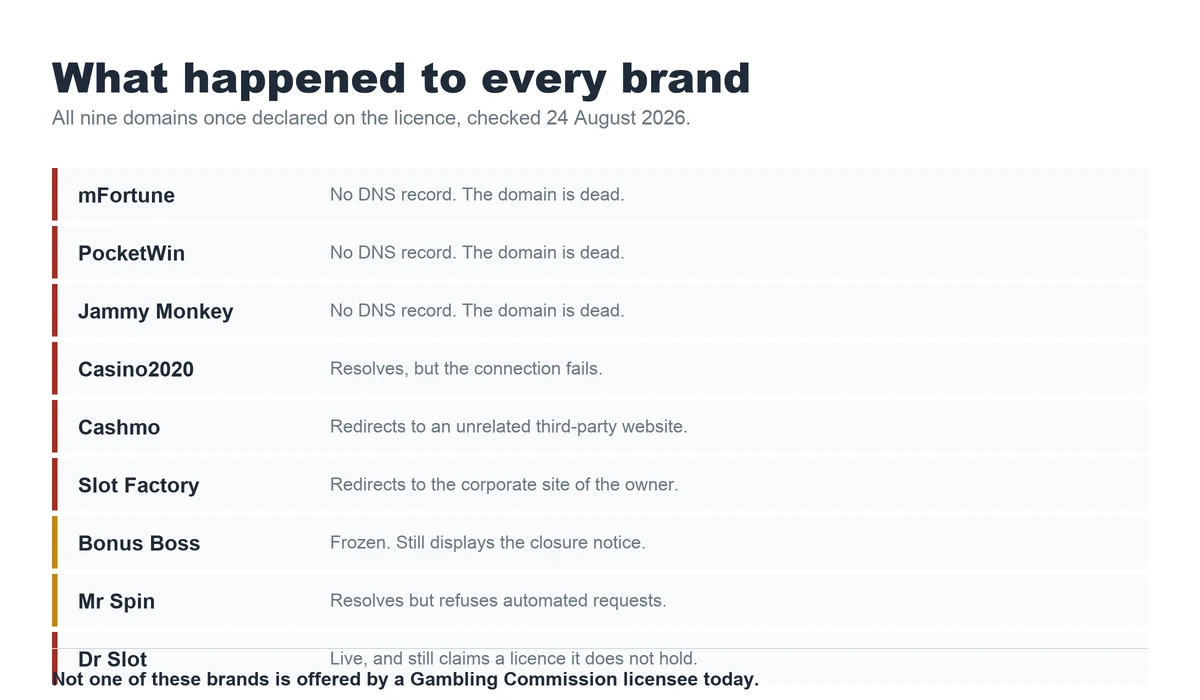
Nine domains were declared on the licence. We checked every one.
Four are simply gone: mFortune, PocketWin and Jammy Monkey have no DNS record at all, and Casino2020 resolves but will not connect. Cashmo now redirects to an unrelated third-party website. Slot Factory redirects to the corporate site of the company’s owner. Bonus Boss is frozen mid-closure, still serving the notice telling customers that the licence had been surrendered with immediate effect and that outstanding balances remained protected.
Three of the brands did get a second life, briefly. mFortune, PocketWin and Jammy Monkey transferred to a Malta company holding its own British licence, which ran them into 2024 — an archived copy of the PocketWin homepage from September 2024 names that operator and its account number in the footer. That company then surrendered its own British licences on 11 November 2024 and its trading names for all three brands are recorded as inactive. The domains lapsed afterwards.
So the sequence is: the original operator exits in September 2023, three brands move to a second licensee, and that licensee exits in November 2024. There is no third act.
The Dr Slot problem
One domain does not fit the pattern, and it deserves a warning rather than a description.
drslot.co.uk is live, actively maintained, and carries a 2026 copyright notice. Its footer still states that the site is operated by In Touch Games Ltd at the Birmingham address, and that In Touch Games Limited “is licensed and regulated in Great Britain by the Gambling Commission under account number 2091”.
That statement has been false since 4 September 2023. Account 2091 holds no active licence. The same stale claim appears on Bonus Boss.
The site’s content has also changed character. It now carries a large directory of unrelated third-party casino brands and lists games from studios that In Touch Games never made. We could not establish who controls the domain today, and we are not going to speculate. What we can say plainly is that a British consumer reading that footer would be misled about the regulatory status of what they are looking at.
The same caution applies more widely. A search for mFortune surfaces a cluster of lookalike domains marketing to British players. None appears on the Gambling Commission register. Treat every one as unlicensed unless you can find it there yourself.
The sale, and the fraud claim that followed
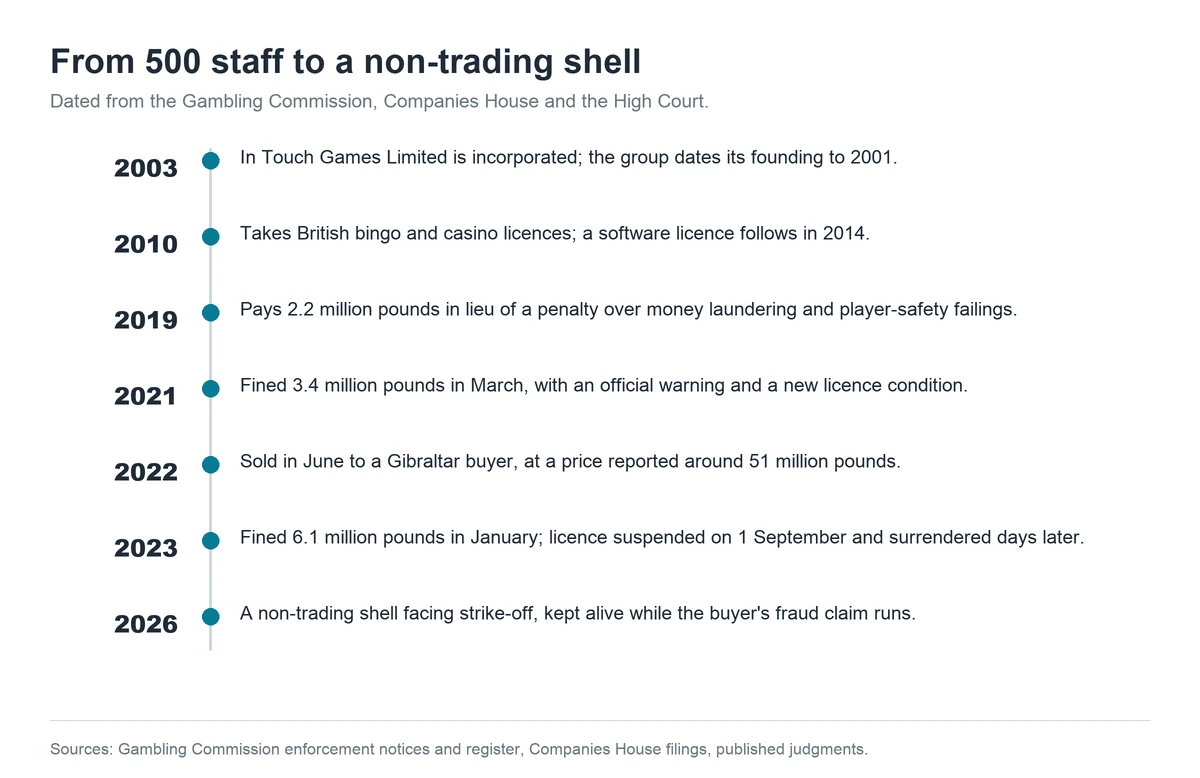
In June 2022, fifteen months before the licences went, the two founding shareholders sold the company to a Gibraltar-registered acquirer, at a price reported in the trade press at around £51 million. The Companies House record confirms the change of control on 2 June 2022.
The buyer is now in the High Court trying to undo it. A Commercial Court claim brought by the acquirer and by In Touch Games itself alleges breach of warranty, fraudulent misrepresentation and conspiracy. The pleaded case includes an allegation that during a regulatory audit in 2021, customer bank statements and payslips were forged in order to deceive the Gambling Commission about anti-money-laundering and responsible-gambling compliance. The buyer is reported to be seeking to unwind the acquisition entirely.
Two things must be said clearly. The defendants dispute the allegations in full. And the only judgment we could find is a pre-trial ruling from December 2025, which listed a trial for early 2026. We could find no published trial judgment and no reported outcome, so nothing here has been decided by a court.
It does, however, explain the company’s odd afterlife on the register. In Touch Games Limited is still technically active, now classified as a non-trading company, with overdue accounts and a live proposal to strike it off — the third such proposal since 2024, each one suspended before it could complete. A company being kept alive against repeated strike-off notices, while producing nothing, is what litigation over its own purchase looks like from the outside.
Can you play these games today?
No, and it is worth being unambiguous about it.
In Touch Games holds no British licence. The Malta company that took three of its brands surrendered its own in November 2024. Four of the domains do not resolve. Offering remote gambling to Great Britain without a licence is unlawful, so any site currently presenting itself to you as mFortune, Dr Slot, Mr Spin, Cashmo or PocketWin is not doing so under British regulation.
That matters more here than with an ordinary studio exit, because these games existed nowhere else. mFortune’s catalogue was built in-house and never licensed out. When the operator went, the games went. There is no lobby you can find them in.
If you held a balance with any of these brands and never withdrew it, the closure notices stated that outstanding balances remained protected and withdrawable. Given the elapsed time and the state of the companies, anyone in that position should contact the Gambling Commission rather than the sites.
How this compares
| Against an ordinary studio exit | Most suppliers that leave Britain simply surrender a software licence and carry on elsewhere, as Live 5 did. This was an operator with three escalating enforcement actions, a regulator-imposed suspension, and a surrender made while a suitability review was under way. |
| Against the scale of the penalties | £11.7 million across three actions is a substantial total for a business of this size, and the Commission explicitly framed the third as escalation for repeated failure. |
| What it says about in-house catalogues | The closed model that made mFortune distinctive is exactly why nothing survived. A studio that licenses its games out leaves a catalogue behind. This one did not. |
Positions as at August 2026.
Safer play
A studio’s reputation, its licences and its published returns tell you whether a game is built properly. None of them tells you a session will go well. Over any period you will actually play, variance dominates the return figure completely.
Decide what an evening is worth before you open anything, and set a deposit limit at your casino rather than relying on judgement in the moment. If gambling has stopped being entertainment, BeGambleAware offers free, confidential support, and GAMSTOP blocks you from every UKGC-licensed site at once.
Our verdict
All Slot Providers score: 2/10.
There is no version of this review that recommends anything. The company is gone, its games are gone with it, and the record it left behind is three escalating enforcement actions in four years, ending in a regulator suspending its licences over concerns about its suitability to hold them at all.
We have given the historic game design a middling six because it deserves it. Building an entire in-house catalogue for mobile, years before mobile-first was the default, was a genuine achievement, and mFortune’s games had a character that licensed content rarely has.
Everything else is a warning. A live site still claims a licence that ended in 2023. A cluster of lookalike domains targets British players using a brand nobody licensed holds. The company itself sits on the register as a non-trading shell, kept from being struck off while its buyer alleges in court that the business it purchased was misrepresented to it.
The useful thing this page can do is answer the question people actually arrive with, which is whether their old account still exists somewhere. It does not.
In Touch Games: FAQs
What happened to mFortune?
Its operator, In Touch Games Limited, had its Gambling Commission licences suspended on 1 September 2023 and surrendered them days later, recorded on the register as ending 4 September 2023. The mFortune brand transferred to a Malta company that ran it into 2024, then surrendered its own British licences on 11 November 2024. The domain no longer resolves.
Was In Touch Games’ licence suspended or revoked?
Suspended, then surrendered. The Gambling Commission suspended all three operating licences on 1 September 2023 while reviewing whether the company was suitable to hold them. The company surrendered rather than complete the review. It was not revoked, and it was not a simple voluntary exit either.
How much was In Touch Games fined?
£11.7 million in total across three actions: £2.2 million in May 2019 paid in lieu of a penalty, a £3.4 million fine in March 2021 with an official warning and a new licence condition, and a £6.1 million fine in January 2023.
Can I still play Dr Slot or Mr Spin?
Not under British regulation. In Touch Games holds no licence. The drslot.co.uk site is still live and its footer still claims a Gambling Commission licence under account 2091, which is false and has been since September 2023.
Who owned In Touch Games?
Two founding shareholders held it until June 2022, when it was sold to a Gibraltar-registered acquirer at a price reported around £51 million. That buyer is now pursuing a High Court claim alleging breach of warranty, fraudulent misrepresentation and conspiracy, and is reported to be seeking to unwind the purchase. The allegations are disputed and no trial judgment has been published.
Why did the Gambling Commission suspend the licence?
It opened a review under section 116 of the Gambling Act 2005 over concerns that activities may have been carried out contrary to the Act and outside licence conditions, and that the licensee might be unsuitable to hold a licence, with suspected failures on money laundering, fair and transparent terms, and reporting key events.
Is In Touch Games still trading?
No. The company remains registered but is classified as a non-trading company, its accounts are overdue, and it faces an active proposal to strike it off — the third since 2024, each suspended before completing.
Jack reviews the studios behind the UK’s online slots, checking every licence claim against the Gambling Commission register and every return figure against the studio’s own published material.